What's Actually Changed for UK Taxpayers in 2026/27 (And What Hasn't)
Income Tax and National Insurance are frozen again this year — here's exactly what did move, and what didn't.
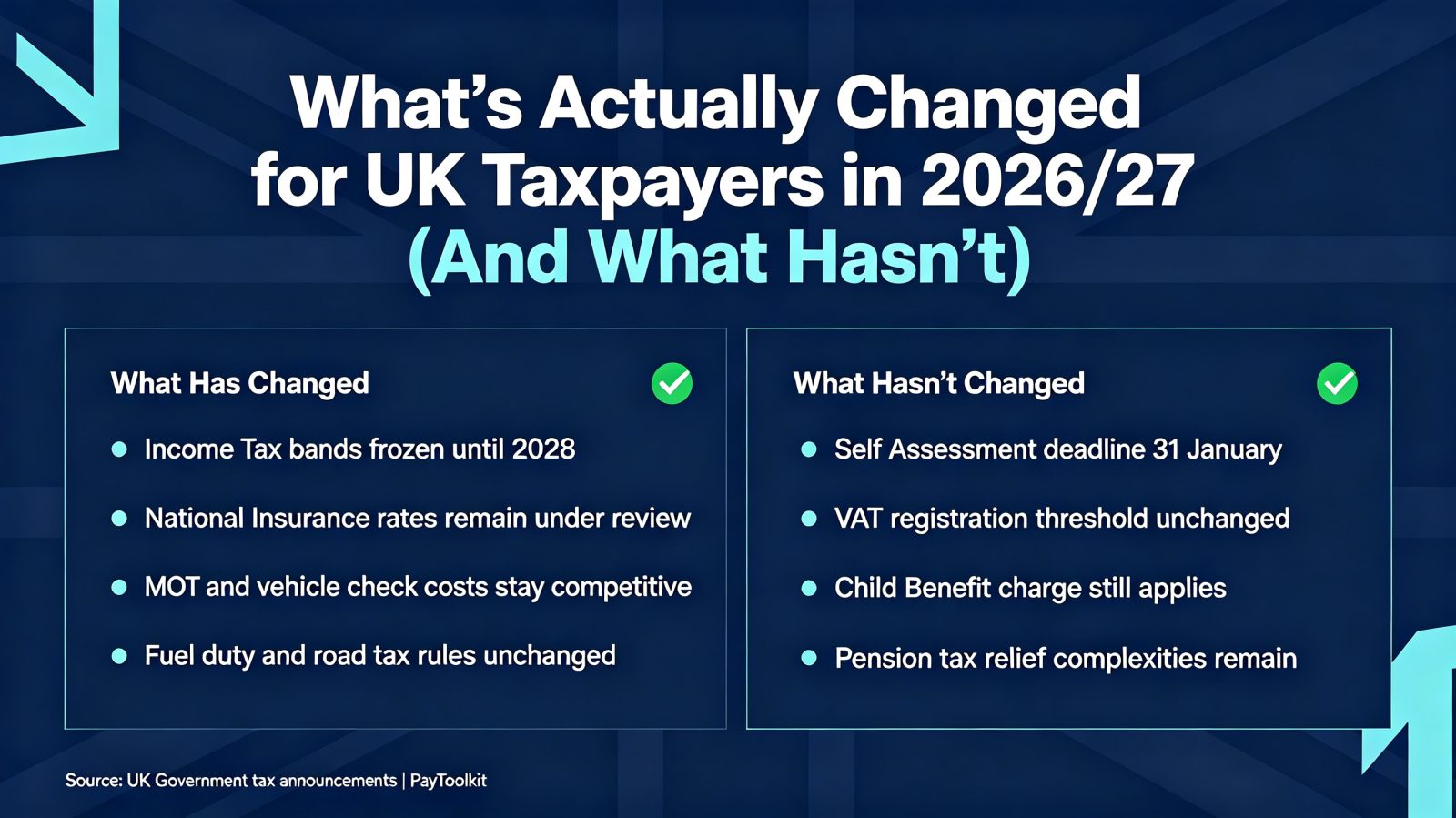
Every April, a wave of headlines declares that "tax changes" are coming into force. Most years, that's technically true — but the headline often overstates how much actually moves. For the 2026/27 tax year, which began on 6 April 2026, the honest answer is more nuanced than most summaries let on: the two biggest levers in the UK tax system, Income Tax and National Insurance, haven't moved at all. What has changed is narrower, and in some cases more important than it first appears, because it affects specific groups rather than everyone.
This guide separates fact from noise. Every figure below is checked directly against HMRC's own published rates and thresholds for 2025/26 and 2026/27, not secondary summaries. If you want the single most useful thing to take away: don't assume last year's numbers changed just because the tax year did. Check before you plan around them.
The headline: Income Tax and National Insurance are frozen
Since 2022, successive governments have kept the Personal Allowance and the main Income Tax thresholds fixed in cash terms rather than uprating them with inflation — a policy usually called a "threshold freeze," and less formally known as fiscal drag. That freeze is still in force for 2026/27, and it means the following figures are identical to 2025/26:
- Personal Allowance: £12,570 (frozen since April 2021, now confirmed frozen until at least April 2028)
- Basic rate band: 20% on income between £12,571 and £50,270
- Higher rate band: 40% on income between £50,271 and £125,140
- Additional rate: 45% above £125,140
- Personal Allowance taper: still withdrawn at £1 for every £2 earned above £100,000, fully gone by £125,140 (the so-called "60% tax trap" in that band)
National Insurance tells the same story. For employees, Class 1 contributions remain 8% on earnings between the Primary Threshold (£12,570) and the Upper Earnings Limit (£50,270), and 2% above that — unchanged from 2025/26. The employer's secondary NI rate (15%) and the Employment Allowance (£10,500) are also unchanged.
This matters because a lot of "tax planning" content gets published every spring assuming rates moved. If you're comparing a payslip from April 2026 to one from March 2026, the tax and NI lines should look almost identical for a like-for-like salary — any difference you see is far more likely to come from a pay rise, a change in pension contribution, or a shifted tax code than from the tax system itself.
What genuinely did change
The freeze on the big levers doesn't mean nothing moved. Several smaller but real changes took effect for 2026/27, and if any apply to you, they're worth knowing about precisely.
Student loan repayment thresholds rose
Unlike Income Tax and NI thresholds, student loan repayment thresholds are reviewed annually and did increase for 2026/27:
Plan2025/26 threshold2026/27 thresholdPlan 1£26,065£26,900Plan 2£28,470£29,385Plan 4 (Scotland)£32,745£33,795Plan 5n/a (new for 2026/27)£25,000Postgraduate Loan£21,000£21,000 (unchanged)
Repayment rates stayed the same — 9% of income above the threshold for Plan 1, 2, 4 and 5, and 6% for the Postgraduate Loan. Plan 5 is worth flagging specifically: it applies to English and Welsh students who started their course from August 2023 onwards, and 2026/27 is effectively its first full year in the system, so if you took out a loan recently, check which plan you're actually on — payroll software sometimes defaults new starters to the wrong plan if HR hasn't updated their records.
The National Minimum Wage went up
From 1 April 2026, the National Living Wage (for workers aged 21 and over) rose from £12.21 to £12.71 an hour — a 4.1% increase. The rates for younger workers and apprentices also rose:
- 18–20 year olds: £10.00 → £10.85
- Under-18s (above school leaving age): £7.55 → £8.00
- Apprentices under 19, or in their first year: £7.55 → £8.00
If you employ staff at or near these rates, this is the single most likely change to actually show up in your payroll costs this year, even though it has nothing to do with the Income Tax or NI systems.
Mileage rates jumped significantly
The approved mileage rate for cars — the amount employers can pay employees tax-free for using their own vehicle on business journeys — rose from 45p to 55p per mile for the first 10,000 business miles in the tax year, effective from June 2026. This is a large jump (a 22% increase) and the first change to this rate in several years; it had been fixed at 45p since 2011. The rate for miles beyond 10,000 remains 25p, and motorcycle (24p) and bicycle (20p) rates are unchanged.
If your employer, or your own business if you're self-employed, is still paying out mileage at the old 45p rate, that's now below the tax-free approved amount and worth raising.
Statutory payments increased
The standard weekly rates for Statutory Sick Pay and the family of statutory family-leave payments (Maternity, Paternity, Adoption, Shared Parental, Parental Bereavement and Neonatal Care Pay) rose modestly, in line with the usual annual uprating:
- Statutory Sick Pay: £118.75 → £123.25 per week
- Statutory Maternity/Paternity/Adoption/Shared Parental/Bereavement/Neonatal Care Pay (standard weekly rate): £187.18 → £194.32 per week
These changes take effect from the first Sunday in April (SSP) and from 5–6 April (the family leave payments), matching the start of the new tax year.
Scotland's Income Tax bands moved — England, Wales and Northern Ireland's didn't
This is the change most likely to be missed by anyone using UK-wide guidance, because it only applies north of the border. While the rUK basic and higher rate thresholds have been frozen since 2022, the Scottish Government uprated several of its own bands for 2026/27:
Scottish band2025/26 threshold2026/27 thresholdStarter rate (19%) upper limit£2,827£3,967Basic rate (20%) upper limit£14,921£16,956Intermediate rate (21%) upper limit£31,092£31,092 (unchanged)Higher rate (42%) upper limit£62,430£62,430 (unchanged)Advanced rate (45%) upper limit£125,140£125,140 (unchanged)Top rate (48%)above £125,140above £125,140 (unchanged)
The Personal Allowance for Scottish taxpayers is still set at the UK-wide £12,570 (the allowance itself is reserved to Westminster; only the bands above it are devolved). The upshot is that a Scottish taxpayer's low-end bands moved slightly in their favour for 2026/27, while their higher bands stayed frozen just like the rest of the UK — meaning any "2025/26 vs 2026/27" comparison genuinely needs separate treatment for Scotland rather than being lumped in with rUK figures.
Why this distinction actually matters
It's tempting to treat "new tax year" and "new tax rules" as synonyms, but for most employed people in England, Wales or Northern Ireland with no student loan, 2026/27 will produce close to identical Income Tax and NI figures to 2025/26 on the same salary. The changes that did happen are real, but they're targeted: they hit people with student loans, low-wage employers, anyone claiming business mileage, and Scottish taxpayers specifically — not the general population uniformly.
This is also, in a quieter way, the story of fiscal drag. Personal Allowance frozen at £12,570 since 2021, and now confirmed frozen until April 2028, means that as wages rise with inflation, more income each year falls into bands that used to be tax-free or basic-rate-only. Nobody's tax rate changed on paper, but more people are paying more tax in real terms simply because the thresholds didn't move while their pay did. That's arguably the biggest "change" of 2026/27 — it's just invisible in a year-on-year rate comparison, because it's been happening steadily since 2021, not something new that started this April.
What to actually check for your own situation
Rather than assuming anything changed, the useful exercise for 2026/27 is to check the specific things that plausibly affect you:
- If you have a student loan, confirm which plan you're on and check the new threshold against your salary — a small pay rise could newly trigger repayments, or a rise below the new threshold could mean repayments you were making in 2025/26 now stop.
- If you employ staff at or near minimum wage, update your payroll to the new NMW rates from 1 April 2026 if you haven't already — this is a legal minimum, not optional.
- If you or your employer pays business mileage, check whether you're still using the old 45p rate; the approved rate is now 55p for the first 10,000 miles.
- If you're a Scottish taxpayer, don't rely on rUK tax band figures — your starter and basic rate bands moved, even though your higher bands and the Personal Allowance didn't.
- Everyone else — if your income, pension contributions and student loan status are unchanged from last year, your Income Tax and NI bill this year should be very close to last year's, adjusted only for any pay change. If it's meaningfully different, the cause is more likely a tax code error, a benefit-in-kind change, or a payroll mistake than the tax year itself.
You can check your own numbers precisely using our Take-Home Pay Calculator, which is kept current with the 2026/27 rates above, or the dedicated Scotland Take-Home Pay Calculator if you pay Scottish Income Tax.
Sources
- HMRC: Rates and thresholds for employers 2025 to 2026
- HMRC: Rates and thresholds for employers 2026 to 2027
- HMRC: Income Tax rates and Personal Allowances — previous tax years
All figures in this article were checked directly against HMRC's published guidance in September 2026. Tax rules can change; always confirm current thresholds before making financial decisions, and consult a qualified accountant for advice on your specific circumstances.
Frequently asked questions
No. The Personal Allowance (£12,570), basic rate threshold (£50,270) and additional rate threshold (£125,140) are all frozen and identical to 2025/26. This freeze has been in place since 2022 and is confirmed to continue until at least April 2028.
No, for employees the Class 1 rates and thresholds are unchanged: 8% on earnings between £12,570 and £50,270, 2% above that. The employer rate (15%) and Employment Allowance (£10,500) are also unchanged.
Student loan repayment thresholds rose for Plans 1, 2 and 4, a new Plan 5 threshold (£25,000) took effect, the National Minimum Wage increased (£12.71/hour for ages 21+), the approved mileage rate rose from 45p to 55p per mile, and Statutory Sick Pay and family leave payments increased slightly.
If your Income Tax and NI figures look different from last year on the same salary, the cause is more likely a tax code change, a benefit-in-kind adjustment, a pension contribution change, or a payroll error — not the 2026/27 tax year itself.
Yes — unlike the rest of the UK, Scotland's starter and basic rate band thresholds were uprated for 2026/27 (starter band upper limit rose to £3,967, basic band to £16,956), while the higher and top bands stayed frozen, matching the rest of the UK.