Understanding Your Take-Home Pay: A Complete Guide for 2026/27
Everything you need to know about calculating, checking, and maximising your net pay
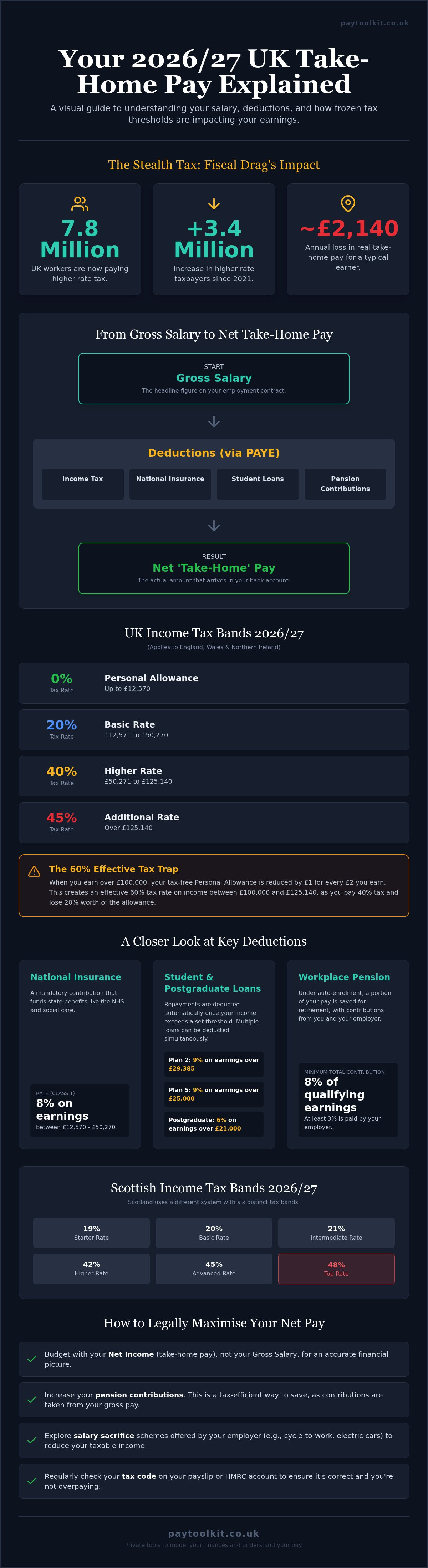
Over 7.8 million UK workers are now paying higher-rate tax, an increase of 3.4 million since 2021. This isn't because everyone suddenly became wealthy; it's the result of fiscal drag. A typical earner on a 2020/21 median wage has lost approximately £2,140 a year in real take home pay by 2026/27 due to frozen tax thresholds. It's a stealth tax. It makes even a generous pay rise feel like a step backward once HMRC and National Insurance take their share.
You've likely felt the sting of your net income stagnating while the cost of living climbs. It's frustrating to see your gross salary increase only for your payslip to tell a different story. We've built this guide to give you total clarity. You'll learn exactly how the 2026/27 tax bands, National Insurance rates, and updated student loan thresholds impact your wallet.
Mastering your salary mechanics is the first step to financial security. We'll walk you through every deduction, from pension auto-enrolment to the 60% tax trap. You'll also discover how to track your earnings privately and explore legal strategies to maximise your net pay. Let's get into the details of your 2026/27 earnings.
Key Takeaways
- Distinguish between gross salary and net earnings to build a budget based on actual cash flow.
- Identify how frozen thresholds and fiscal drag are quietly reducing your purchasing power in 2026.
- Decode every deduction on your payslip, including the 2026/27 National Insurance rates and student loan changes.
- Use legal strategies like salary sacrifice and pension contributions to protect your take home pay.
- Model your 2026 finances with private tools that require no sign-up and store zero personal data.
Table of Contents
- What is Take-Home Pay? Defining Your Net Earnings in 2026
- The Anatomy of Deductions: Where Does Your Salary Go?
- Navigating Fiscal Drag and the 2026/27 Tax Thresholds
- How to Organise Your Finances to Maximise Your Net Income
- Tracking Your Pay Accurately with PayToolkit’s Private Tools
What is Take-Home Pay? Defining Your Net Earnings in 2026
Take-home pay is your bottom line. It's the actual cash that arrives in your bank account on payday after every deduction has been stripped away. For the majority of UK employees, this is managed through the Pay As You Earn (PAYE) system. Your employer calculates your liabilities and sends them directly to HMRC before you even see your wages. The 2026/27 tax year runs from 6 April 2026 to 5 April 2027, and understanding how these dates impact your earnings is the first step to better financial planning.
Your payslip usually contains several layers of deductions. These include:
- Mandatory taxes: Income Tax and National Insurance.
- Statutory repayments: Student loans or postgraduate loans.
- Workplace benefits: Pension contributions or cycle-to-work schemes.
- Court orders: Attachment of earnings or child maintenance.
Gross vs Net: Why the Difference Matters
Your gross salary is the headline figure. It's the number on your contract, the amount you quote on mortgage applications, and the figure lenders use to assess your borrowing power. However, Net Income is the reality you live with. It is synonymous with your take home pay. The gap between these two numbers can be startling. Your employer essentially acts as an unpaid tax collector for the government, ensuring HMRC gets its cut first. This makes your tax code one of the most important numbers in your life. Don't ignore it. An incorrect code can lead to months of overpaying or a nasty surprise bill later in the year. Checking it annually ensures your monthly budget remains accurate.
The Role of the Personal Allowance in 2026
The Personal Allowance is the portion of your income that you keep entirely tax-free. For the 2026/27 tax year, the standard allowance is £12,570. If you earn less than this, you won't pay any Income Tax at all. For everyone else, it's the foundation of your take home pay. However, this safety net isn't available to everyone at the same level. If your income exceeds £100,000, your allowance begins to taper. It drops by £1 for every £2 you earn above that limit. By the time you reach £125,140, your Personal Allowance disappears completely. This creates a "60% tax trap" where you lose a significant portion of your earnings to tax and the loss of the allowance. Knowing where you stand on this scale helps you decide whether to take that next promotion or increase your pension contributions instead.
The Anatomy of Deductions: Where Does Your Salary Go?
Your gross salary is just a starting point. By the time it reaches your bank account as take home pay, several agencies have taken their cut. Mandatory deductions like Income Tax and National Insurance Contributions (NICs) form the bulk of this gap. By 2026, NICs remain a primary funding source for the NHS and social care services, calculated at 8% on earnings between £12,570 and £50,270. Workplace pensions also play a major role. Under auto-enrolment, the total minimum contribution is 8% of your qualifying earnings, with your employer providing at least 3%.
Income Tax Bands and Rates for 2026/27
For the 2026/27 tax year, the tax bands in England, Wales, and Northern Ireland are fixed. You pay 20% on income between £12,571 and £50,270, and 40% on anything from £50,271 up to £125,140. Earnings over £125,140 trigger the 45% Additional Rate. In Scotland, the system is more granular. It features six bands ranging from the 19% Starter Rate to a 48% Top Rate for income over £125,140. Your marginal tax rate is the specific percentage of tax paid on every additional pound of income you earn. Understanding this helps you see why a £5,000 pay rise doesn't always result in £5,000 of extra cash. You can Estimate your Income Tax to see how these bands apply to your specific situation.
Student Loans and Postgraduate Repayments
Student loan repayments function more like a graduate tax than a standard bank loan. They only trigger once you earn above a specific threshold. For 2026/27, Plan 2 borrowers start paying when they earn over £29,385, while Plan 5 borrowers have a lower threshold of £25,000. Deductions are typically 9% of everything you earn above those limits. Postgraduate loans add another 6% deduction on earnings over £21,000. These deductions are calculated and removed automatically by your employer. If you want to see how these variables interact with your take home pay, use a free salary calculator to model different scenarios without sharing your personal data.
Navigating Fiscal Drag and the 2026/27 Tax Thresholds
Fiscal drag is a quiet thief. It occurs when tax thresholds remain static while wages rise to keep pace with inflation. Because the Personal Allowance and Higher Rate thresholds have been frozen since April 2021, more of your income is forced into higher tax brackets over time. The 2026/27 tax year represents the fifth year of this freeze. Even if your salary hasn't changed, the rising cost of goods means your take home pay buys less than it did five years ago. The current government has extended this freeze until April 2031, ensuring this pressure on your earnings continues for the foreseeable future.
This "stealth tax" has fundamentally changed the UK tax landscape. The number of higher-rate taxpayers has increased from 4.4 million in 2021/22 to 7.8 million in 2026/27. Millions of people who previously paid the Basic Rate are now losing 40% of their top-end earnings to HMRC. This shift happens without a single official tax rate increase, making it a powerful but often invisible tool for increasing tax revenue at the expense of your net income.
Why Your Pay Rise Might Feel Smaller
A 3% pay rise in 2026 might look good on paper, but it rarely translates to a 3% increase in your bank account. Under frozen thresholds, that extra money often falls entirely into your highest tax band. This "bracket creep" hits middle-income earners hardest. A typical UK earner on a 2020/21 median wage has lost approximately £2,140 a year in real income by 2026/27. To see the true value of a bonus or raise, calculate the net result first. If you are close to the £50,270 threshold, your entire bonus might be taxed at 40% rather than 20%, significantly dampening the reward for your hard work.
The 60% Tax Trap and Personal Allowance Taper
The most punitive part of the UK tax system is the "60% tax trap" occurring between £100,000 and £125,140. In this band, you lose £1 of your Personal Allowance for every £2 of additional income earned. This creates an effective tax rate of 60% on that specific portion of your earnings. When you factor in National Insurance and potential student loan repayments, your take home pay can feel almost stagnant despite a high gross salary. PayToolkit’s specialised calculator helps identify this trap instantly. It shows you exactly where the taper begins so you can make informed decisions about salary sacrifice or pension contributions to protect your earnings.
How to Organise Your Finances to Maximise Your Net Income
Increasing your gross salary isn't the only way to boost your take home pay. In a year defined by frozen thresholds, efficiency is your best tool. Salary sacrifice schemes allow you to give up a portion of your pre-tax wages in exchange for non-cash benefits. Because the deduction happens before HMRC takes its cut, you pay less Income Tax and National Insurance. This effectively lowers your taxable income, which is particularly useful if you're hovering near the Higher Rate threshold or the 60% tax trap.
Don't overlook the Marriage Allowance if you are married or in a civil partnership. If one partner earns less than the £12,570 Personal Allowance, they can transfer £1,260 of their unused allowance to the higher-earning partner. This can reduce the couple's tax bill by up to £252 per year. It's a simple adjustment that provides a small but guaranteed boost to your household's net earnings.
The Power of Salary Sacrifice
Sacrificing salary for a pension is a double win. It builds your future wealth while providing immediate tax relief. Unlike standard contributions, salary sacrifice also reduces your National Insurance bill. This happens because your official gross salary is lower on paper. Common items you can sacrifice salary for include:
- Workplace Pensions: The most common and effective way to save tax.
- Cycle to Work Scheme: Save on the cost of a new bike and equipment.
- Electric Car Leases: Benefit from low Benefit-in-Kind (BIK) rates.
- Childcare Vouchers: Only available if you joined a scheme before October 2018.
There is a trade-off. Most mortgage lenders base their borrowing limits on your gross pay. If you sacrifice a significant amount, your maximum loan size might decrease. Always balance your immediate tax savings against your long-term borrowing needs. You can use the Tax Tracker Dashboard to see how different sacrifice levels impact your monthly budget.
Claiming Working from Home and Professional Expenses
Many employees are entitled to tax relief on costs related to their jobs. If you must wear a specific uniform or use specialised tools, you can often claim for laundry and maintenance costs. Professional subscriptions to bodies like the NMC or various trade unions are also eligible for relief. Regarding working-from-home relief, the 2026 rules generally require you to have no choice but to work from home to claim the standard £6 per week allowance. If your employer requires your presence in an office, you likely won't qualify. Check your eligibility for these small gains; they add up over a full tax year and help protect your take home pay from unnecessary erosion.
Tracking Your Pay Accurately with PayToolkit’s Private Tools
Predicting your finances shouldn't feel like a guessing game. While official government portals provide guidance, they often require personal logins and multi-step verification. We've built the PayToolkit Take-Home Pay Calculator to be the fastest, most private way to check your 2026 earnings. It is fully aligned with the confirmed 2026/27 HMRC rates, ensuring your results are precise. Whether you are dealing with the 60% tax trap or simply want to see the impact of a new tax code, you get instant answers without the friction of a corporate portal.
Managing your money works best when you have a holistic view. Our Tax Tracker Dashboard allows you to monitor your earnings across the entire tax year. You can model different scenarios, adjust for mid-year pay rises, and see how your net income fluctuates. It's a reliable utility designed to remove the stress of complex tax calculations, giving you the data you need to plan your household budget with confidence.
Why Privacy Matters for Financial Tools
Entering your salary into a random website often comes with a hidden cost. Many financial tools are designed to harvest your data, building user profiles that are sold to advertisers or insurance companies. We've taken a different approach. PayToolkit operates with a strict "No Sign-up" policy. Your financial data stays on your device. We don't store your salary, your name, or your tax code. This commitment to transparency ensures you can check your take home pay with total peace of mind. Bookmark the tool for your monthly payslip checks to ensure your employer is deducting the correct amount.
Beyond the Salary: VAT, Dividend, and Side-Hustle Tools
The modern UK workforce is rarely limited to a single PAYE payslip. You might be a sole trader, a contractor receiving dividends, or someone with a growing side-hustle. PayToolkit supports this complexity. Our suite includes dedicated Sole Trader Tax & NI, VAT, and Dividend Tax calculators. These tools allow you to see how different income streams interact, providing a complete picture of your total take home pay. You don't need to be a tax expert to use them; the interface handles the heavy lifting so you can focus on your work. Calculate your 2026/27 take-home pay now on PayToolkit and take control of your net earnings today.
Take Control of Your 2026 Earnings
Understanding the gap between your gross salary and your actual bank balance is vital for financial stability. You've seen how fiscal drag and the 60% tax trap can quietly reduce your purchasing power. By identifying exactly where your money goes, from National Insurance to student loan repayments, you can make smarter choices about your career and savings. Strategies like salary sacrifice aren't just for experts; they are practical tools you can use to protect your take home pay from unnecessary erosion.
Predicting your monthly budget shouldn't be a chore. Our tools provide the precision you need without the privacy risks of traditional financial sites. Check your 2026/27 take-home pay on the PayToolkit Salary Calculator to see your results instantly. Every calculation is HMRC-aligned for the current year, requires no sign-up, and follows a privacy-first design that keeps your data safe. Take the guesswork out of your payslip and start planning your future with confidence.
Frequently Asked Questions
How is take-home pay calculated in the UK for 2026?
Your take home pay is calculated by subtracting mandatory and voluntary deductions from your gross salary. For the 2026/27 tax year, this includes Income Tax based on your specific band, Class 1 National Insurance at 8% or 2%, and any student loan repayments. Other factors like pension contributions and salary sacrifice also reduce the final amount. Using an updated calculator ensures these specific 2026 thresholds are applied correctly to your monthly budget.
What is the personal allowance for the 2026/27 tax year?
The standard Personal Allowance for the 2026/27 tax year is £12,570. This is the amount you earn before paying any Income Tax. This figure has remained frozen since 2021 as part of the government's fiscal drag strategy. If you earn over £100,000, this allowance tapers away at a rate of £1 for every £2 of additional income. By the time you reach £125,140, your tax-free allowance is completely removed.
Can I use a take-home pay calculator for multiple jobs?
Yes, you can use a calculator for multiple jobs, but you must enter the details for each separately. HMRC usually applies your full Personal Allowance to your main job, meaning your second job is often taxed at the Basic Rate of 20% from the first pound. Ensure you check your tax codes for both roles. If your total income from all sources pushes you into the Higher Rate band, you may owe additional tax.
How do student loan repayments affect my monthly net pay?
Student loan repayments are calculated as a percentage of your income above a specific threshold. For 2026/27, Plan 2 borrowers pay 9% on earnings over £29,385, while Plan 5 borrowers pay 9% on everything over £25,000. These deductions are taken directly from your gross pay alongside tax and NI. Because they are calculated on your gross income, they can significantly reduce your monthly net earnings depending on your specific repayment plan.
Is National Insurance changing in 2026?
For the 2026/27 tax year, National Insurance rates for employees are set at 8% on earnings between £12,570 and £50,270. Any earnings above the £50,270 threshold are taxed at a lower rate of 2%. While the headline rates have seen adjustments in previous budgets, the thresholds remain frozen. This means as your wages rise, a larger portion of your income becomes subject to these mandatory contributions, affecting your final take home pay.
What is the "60% tax trap" and how do I avoid it?
The 60% tax trap occurs when your income falls between £100,000 and £125,140. In this band, you lose 40% in Higher Rate tax plus the loss of your Personal Allowance, creating an effective 60% tax rate. You can avoid this by using salary sacrifice schemes to lower your taxable income below £100,000. Increasing your workplace pension contributions is one of the most effective ways to bypass this trap and keep more of your earnings.
Do I need to sign up to use the PayToolkit salary calculator?
No, you do not need to sign up or provide any personal details to use our tools. PayToolkit is built with a privacy-first design, meaning your financial data stays on your own device. We don't store your salary information or build user profiles to sell to third parties. Our goal is to provide a reliable, no-nonsense utility that gives you instant results without the need for an account or email registration.
How does salary sacrifice affect my final take-home pay?
Salary sacrifice reduces your gross pay on paper, which in turn lowers the amount of Income Tax and National Insurance you pay. While your headline salary decreases, the net value of your benefits, such as a higher pension pot or a new bike, often exceeds the reduction in cash. It is a legal way to optimise your earnings. Always check how a specific sacrifice affects your take-home cash before committing to the scheme.