HMRC Tax Bands 2026/27: A Complete Guide to UK Income Tax Brackets
See the current Personal Allowance, Basic, Higher and Additional Rate thresholds, plus how National Insurance and the 60% tax trap affect your take-home pay.

Did you know that even if your salary stays exactly the same, you could still end up paying more to the taxman this year? With thresholds frozen until 2031, "fiscal drag" is quietly pulling thousands of workers into higher brackets without a single headline rate change. Understanding the HMRC tax bands 2026/27 is the only way to protect your budget and plan your finances with certainty.
It's frustrating to watch your take-home pay stagnate while the cost of living continues to climb. You want to know exactly how much of your salary is yours to keep and where the hidden tax traps lie. We've got you covered. Our guide provides a clear breakdown of every income bracket, the current Personal Allowance, and the specific regional variations that affect taxpayers in Scotland.
We'll show you the exact figures for the basic, higher, and additional rates. You'll also learn how the tapering of the Personal Allowance creates an effective 60% tax rate for high earners. By the end, you'll have all the data needed to calculate your net pay accurately and avoid any nasty surprises from HMRC.
Key Takeaways
- Confirm your tax-free threshold for the year. The standard Personal Allowance remains at £12,570, though this reduces once your income exceeds £100,000.
- Navigate the HMRC tax bands 2026/27 with ease. See a clear breakdown of the basic, higher, and additional rates for England, Wales, and Northern Ireland.
- Spot the regional differences in Scotland. Learn how the devolved six-tier system impacts your earnings compared to the rest of the UK.
- Identify the 60% tax trap before it affects your budget. We explain the effective tax rate triggered by the tapering of the Personal Allowance for high earners.
- Calculate your net income in seconds. Use our frictionless tools to transform these complex percentages into an accurate take-home pay figure.
Table of Contents
- Understanding the 2026/27 Personal Allowance
- HMRC Tax Bands for England, Wales, and Northern Ireland
- Scottish Income Tax Bands: How They Differ in 2026/27
- Navigating the 60% Tax Trap and Fiscal Drag
- How to Calculate Your 2026/27 Take-Home Pay
Understanding the 2026/27 Personal Allowance
The Personal Allowance is the tax-free foundation of UK earnings. For the 2026/27 tax year, this figure remains at £12,570. This means you can earn up to this amount before you start paying any Income Tax to HMRC. Whilst the headline figure hasn't changed, its impact certainly has.
Because the threshold is frozen until 2031, many workers are experiencing "fiscal drag." As wages rise to keep up with inflation, a larger portion of your income falls above the £12,570 limit. This effectively increases the tax burden without the government needing to raise the actual HMRC tax bands 2026/27. It's a subtle way for the Treasury to collect more revenue while keeping the primary rates static.
The £100,000 Personal Allowance Taper
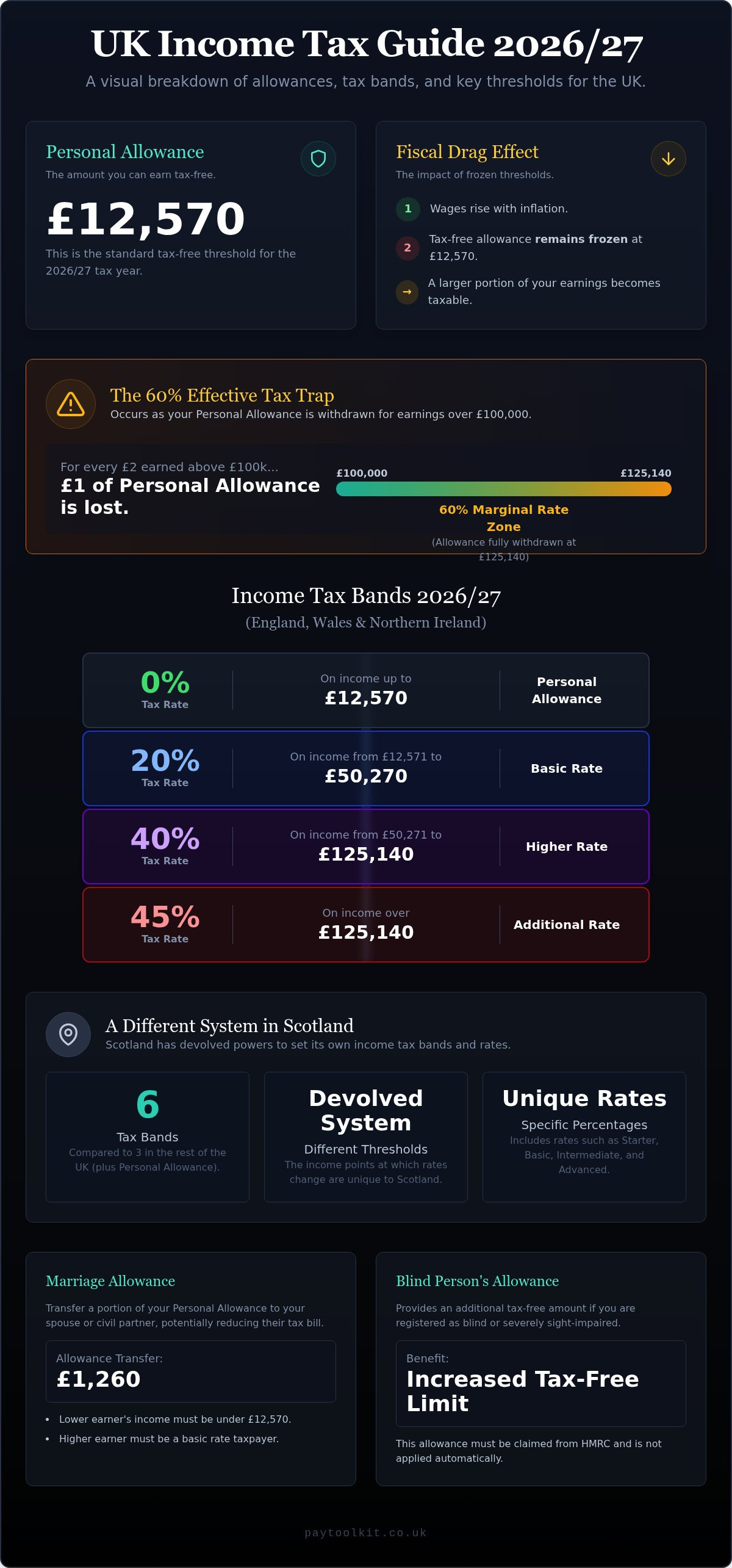
High earners face a specific challenge once their adjusted net income passes the £100,000 mark. For every £2 you earn above this threshold, you lose £1 of your Personal Allowance. This creates a "taper" that continues until your allowance reaches zero.
The allowance disappears entirely once you earn £125,140. This creates a significant spike in your effective tax rate. Because you're paying 40% tax on the income and losing the tax-free status of your earlier earnings simultaneously, the marginal rate in this bracket effectively hits 60%. It's one of the most complex areas of Taxation in the United Kingdom, often catching professionals by surprise.
Blind Person’s Allowance and Marriage Allowance
You might be entitled to a higher tax-free threshold through specific claims. The Marriage Allowance is a popular choice for couples. It allows you to transfer £1,260 of your Personal Allowance to your husband, wife, or civil partner.
To qualify for this transfer:
- The lower-earning partner must earn less than the £12,570 Personal Allowance.
- The higher-earning partner must be a basic rate taxpayer.
- Both partners must have been born after 5 April 1935.
The Blind Person’s Allowance also provides an additional tax-free amount for those registered as blind or severely sight impaired. These adjustments are vital because they provide a way to increase your tax-free limit beyond the standard HMRC tax bands 2026/27. Remember that HMRC won't apply these automatically; you must contact them to update your tax code or include them on your Self Assessment return.
HMRC Tax Bands for England, Wales, and Northern Ireland
The HMRC tax bands 2026/27 follow a progressive system. This means you only pay a higher rate of tax on the money that falls within that specific bracket. If you earn £55,000, you don't pay 40% on the whole amount. Instead, you pay 0% on your Personal Allowance, 20% on the middle chunk, and 40% only on the final £4,730. This "marginal" approach ensures that getting a pay rise doesn't leave you with less money in your pocket.
These specific thresholds and rates apply to taxpayers in England, Wales, and Northern Ireland. While the Welsh Government has the power to vary rates, they have historically remained aligned with the UK government's figures. Scotland, however, operates a completely different system with more tiers, which we'll cover later in this guide.
The 2026/27 income tax brackets are:
- Personal Allowance: 0% on income up to £12,570
- Basic Rate: 20% on income between £12,571 and £50,270
- Higher Rate: 40% on income between £50,271 and £125,140
- Additional Rate: 45% on income over £125,140
The Basic Rate (20%) Threshold
The basic rate is where the majority of UK workers sit. It covers every pound earned between £12,571 and £50,270. It's important to remember that Income Tax isn't your only deduction. National Insurance (NI) contributions are calculated separately and added to your tax bill. For employees in 2026/27, the main Class 1 NI rate is 8% on weekly earnings between £242 and £967. You can use a free take-home pay calculator to see exactly how these combined figures impact your monthly bank balance.
The Higher Rate (40%) and Additional Rate (45%)
Once your income exceeds £50,270, you enter the higher rate band. This 40% rate applies to earnings up to £125,140. While many people believe the 45% additional rate starts at £150,000, it was lowered to £125,140 in recent years. This change effectively means you lose your entire Personal Allowance at the same moment you start paying the highest rate of tax.
Checking the Official income tax rates confirms that the additional rate remains at 45% for the 2026/27 tax year. Because the thresholds for these HMRC tax bands 2026/27 are currently frozen, more people are finding themselves paying 40% tax as their salaries increase. This is the "fiscal drag" mentioned earlier. It makes understanding your exact bracket essential for accurate financial planning.
Scottish Income Tax Bands: How They Differ in 2026/27
The Scottish Parliament uses its devolved powers to set Income Tax rates that differ significantly from the rest of the UK. While the Personal Allowance remains a UK-wide constant at £12,570, the way income above that limit is taxed follows a much more granular path. Instead of the three-tier system found in England, Scotland operates a six-tier structure. This means the HMRC tax bands 2026/27 for Scottish residents are more complex and often result in higher earners paying more than their counterparts elsewhere in Britain.
The 2026/27 Scottish Tax Brackets
The Scottish system is designed to be more progressive. It starts with a lower "Starter Rate" but quickly climbs through intermediate levels. For the 2026/27 tax year, the brackets are:
- Starter Rate (19%): £12,571 to £15,397
- Basic Rate (20%): £15,398 to £27,491
- Intermediate Rate (21%): £27,492 to £43,662
- Higher Rate (42%): £43,663 to £75,000
- Advanced Rate (45%): £75,001 to £125,140
- Top Rate (48%): Over £125,140
A major point of divergence is the Higher Rate threshold. In England, Wales, and Northern Ireland, you don't hit the 40% bracket until your income exceeds £50,270. In Scotland, the 42% Higher Rate kicks in much earlier at £43,663. High earners also face a Top Rate of 48%, which is three percentage points higher than the Additional Rate used in the rest of the UK. You can find more detail on these specific variations in the official UK government guidance.
Determining Your Tax Residency
Your tax status depends on where you live for most of the year, not where your employer is based. If your main home is in Scotland, you are a Scottish taxpayer. This rule applies even if you commute to an office located elsewhere in the UK or work remotely for a company based in a different region. It's about your residential ties and physical presence. HMRC identifies Scottish taxpayers using an "S" prefix on their tax code. If your code is S1257L, you're being taxed at Scottish rates.
Mistakes happen, especially if you've recently moved across the border. Always keep HMRC updated with your current address. A delay in reporting a move could lead to an incorrect tax calculation and a surprise bill at the end of the year. Understanding these HMRC tax bands 2026/27 ensures you're prepared for the specific rates applied to your Scottish residency. It's a simple step that prevents long-term administrative headaches.
Navigating the 60% Tax Trap and Fiscal Drag
The 60% tax trap is a mathematical quirk that hits earners between £100,000 and £125,140. While the headline higher rate is 40%, the gradual removal of your Personal Allowance adds an extra 20% effective tax. For every £100 you earn in this bracket, you keep only £40. It's one of the most punitive elements of the UK tax system. Because this isn't an official "band" on a government table, many professionals don't realise they're being taxed at this rate until their January tax bill arrives.
Fiscal drag makes this situation worse for more people every year. Because the HMRC tax bands 2026/27 are frozen while wages rise to meet inflation, pay rises often result in a higher percentage of your income being taken by the state. You aren't getting wealthier in real terms; you're just being dragged into a more expensive bracket. Adjusted Net Income is the key metric for these tapers, representing your total taxable income minus specific deductions like pension contributions and Gift Aid.
Strategies to Avoid the Tax Trap
Pension contributions are your strongest tool to fight the 60% trap. If you earn £110,000, a £10,000 pension contribution brings your Adjusted Net Income back down to £100,000. This move saves you £4,000 in Income Tax and restores £5,000 of your Personal Allowance. You've effectively "saved" £6,000 in tax while putting £10,000 into your future. It's a logic-defying benefit of the current system that every high earner should consider.
Charitable donations under Gift Aid work in a similar way. They extend your basic rate band and protect your allowance from being tapered away. To see how these adjustments change your actual take-home pay, use our 60% tax trap calculator. It provides an instant breakdown of your effective tax rate and shows how much you could save through smart contributions.
The Impact of the Child Benefit Tax Charge
The High Income Child Benefit Charge (HICBC) adds another layer of complexity for parents. If you or your partner earn over the threshold, you must pay back a portion of the benefit through your tax return. Currently, the charge starts at £60,000, and the benefit is fully repaid once income hits £80,000. For parents in this bracket, the combined impact of Income Tax, National Insurance, and the HICBC can lead to incredibly high marginal rates.
The charge is collected through Self Assessment. If you're an employee who usually pays tax through PAYE, this can be a shock. You'll need to register for a tax return and pay the balance by 31 January following the end of the tax year. Understanding where you sit within the HMRC tax bands 2026/27 helps you set aside enough cash to cover this bill and avoid HMRC penalties. It's about staying ahead of the "cliff edges" that the frozen thresholds create.
How to Calculate Your 2026/27 Take-Home Pay
Understanding the rules is one thing. Seeing the actual impact on your bank account is another. We've built the PayToolkit Free UK Salary & Take-Home Pay Calculator to bridge that gap. It's a direct, no-nonsense tool designed to handle the complexities of the HMRC tax bands 2026/27 without the usual corporate friction or data harvesting.
Using the Salary Calculator for 2026/27
Input your gross salary or hourly rate. The tool instantly applies the correct rates for your specific region, whether you live in England, Wales, Northern Ireland, or Scotland. Both PAYE employees and self-employed individuals can get accurate results. It doesn't just calculate basic income tax. It integrates National Insurance, pension contributions, and student loan repayments to give you a true net figure.
You can toggle between different tax codes or adjust for specific pension percentages. This is particularly useful if you're trying to stay below a certain threshold to avoid the 60% trap we discussed. Being able to compare your monthly vs annual take-home pay at a click helps you budget with precision. It's about removing the guesswork from your monthly finances.
Most financial tools demand an email address before showing you results. We don't. There's no signup required and no personal data stored on our servers. It's a privacy-first utility that prioritises your time and your security. You get the answers you need and can move on with your day.
Privacy-First Tax Tracking
Monitoring your income across the entire year is the best way to avoid a surprise tax bill. Our Free Tax Tracker Dashboard provides a comprehensive view of your tax year at a glance. You can track multiple income streams, such as a side hustle alongside a main job, and see how they interact with the HMRC tax bands 2026/27 in real time. This is essential for anyone whose income fluctuates throughout the year.
Because the dashboard works without an account, your financial data stays on your device. It acts as a meticulous architect for your personal finances. You can see exactly how much of your annual allowance remains and when you might be approaching a higher bracket entry point. It provides the same level of insight as a professional accountant, but through a frictionless digital interface that respects your privacy.
Take Control of Your 2026/27 Finances
The HMRC tax bands 2026/27 are now clear. While the £12,570 Personal Allowance remains the standard, fiscal drag and regional variations in Scotland mean your take-home pay is far from static. You've seen how the 60% tax trap can quietly erode your earnings and why understanding your specific tax residency is vital for accurate planning. Staying ahead of these stealth taxes requires more than just knowing the headline rates; it requires a proactive approach to your monthly budget.
Don't let frozen thresholds catch you off guard. We've built our tools to provide instant clarity without the usual corporate barriers. Trusted by thousands of UK taxpayers, our system uses the latest HMRC rates to deliver precise results every time. You can calculate your 2026/27 take-home pay instantly with PayToolkit. There's no signup required and we never store your personal data. It's a simple, privacy-first way to manage your money with confidence. Start planning today and ensure you're keeping as much of your hard-earned income as possible. You have the tools to handle these changes successfully.
Frequently Asked Questions
What is the standard HMRC Personal Allowance for 2026/27?
The standard Personal Allowance for the 2026/27 tax year is £12,570. This is the amount you can earn before paying any Income Tax. It remains frozen at this level as part of the government's long-term fiscal strategy. Most taxpayers in the UK receive this full amount. However, it starts to reduce if your adjusted net income exceeds £100,000, eventually reaching zero once you earn £125,140.
How much can I earn before I pay 40% tax in 2026/27?
In England, Wales, and Northern Ireland, you start paying the 40% Higher Rate on income above £50,270. This means the HMRC tax bands 2026/27 apply the 40% rate to every pound earned between £50,271 and £125,140. If you live in Scotland, this threshold is significantly lower. Scottish residents enter the Higher Rate band at £43,663, though the rate there is 42% rather than 40%.
Is the 60% tax trap real and how do I calculate it?
The 60% tax trap is a real effective rate that hits earnings between £100,000 and £125,140. It happens because you pay 40% Income Tax while simultaneously losing £1 of your Personal Allowance for every £2 earned. This combination means for every £100 in this bracket, you lose £60 to tax. You can calculate your specific exposure using a dedicated calculator to see the impact on your take-home pay.
Are the tax bands different in Scotland for the 2026/27 year?
Yes, Scotland uses a separate six-tier system for the 2026/27 tax year. These bands range from the 19% Starter Rate to the 48% Top Rate. While the Personal Allowance is the same across the UK, the thresholds for the Higher, Advanced, and Top rates in Scotland differ from the rest of the country. This often results in Scottish taxpayers paying more than those in England on identical salaries.
What happens to my tax band if I earn over £125,140?
Once your income exceeds £125,140, you lose your Personal Allowance entirely and enter the Additional Rate band. At this point, you pay 45% tax on all earnings above this threshold in England, Wales, and Northern Ireland. In Scotland, the Top Rate of 48% applies to this income. Because your tax-free allowance is gone, every single pound you earn is subject to at least the basic rate of tax.
How do pension contributions affect my tax bracket?
Pension contributions reduce your Adjusted Net Income, which can effectively lower your tax bracket. If your salary is just inside the Higher Rate band, a pension contribution could pull your taxable income back into the 20% Basic Rate. This strategy is particularly effective for those caught in the 60% tax trap. It allows you to reclaim your Personal Allowance while building your future savings tax-efficiently without needing complex professional advice.
Can I track my tax for 2026/27 without a government gateway account?
You can track your HMRC tax bands 2026/27 and total earnings using the PayToolkit Tax Tracker Dashboard. This tool allows you to monitor your income and estimated tax bill throughout the year without needing a government login or account. It's a privacy-first solution that keeps your data on your own device. You get an instant overview of your tax position without the administrative friction or delays of official portals.
What is fiscal drag and why does it matter for my salary?
Fiscal drag occurs when tax thresholds stay the same while wages rise due to inflation or pay increases. Because the government has frozen the Personal Allowance and Higher Rate thresholds until 2031, more of your salary is dragged into higher tax brackets over time. It's a subtle way to increase tax revenue without changing headline rates. This makes your real-world take-home pay feel smaller even if your gross salary increases.