Class 2 vs Class 4 National Insurance: What Self-Employed People Actually Pay in 2026/27
Class 2 changed in 2024 and most self-employed people no longer pay it — here's what actually happens now.
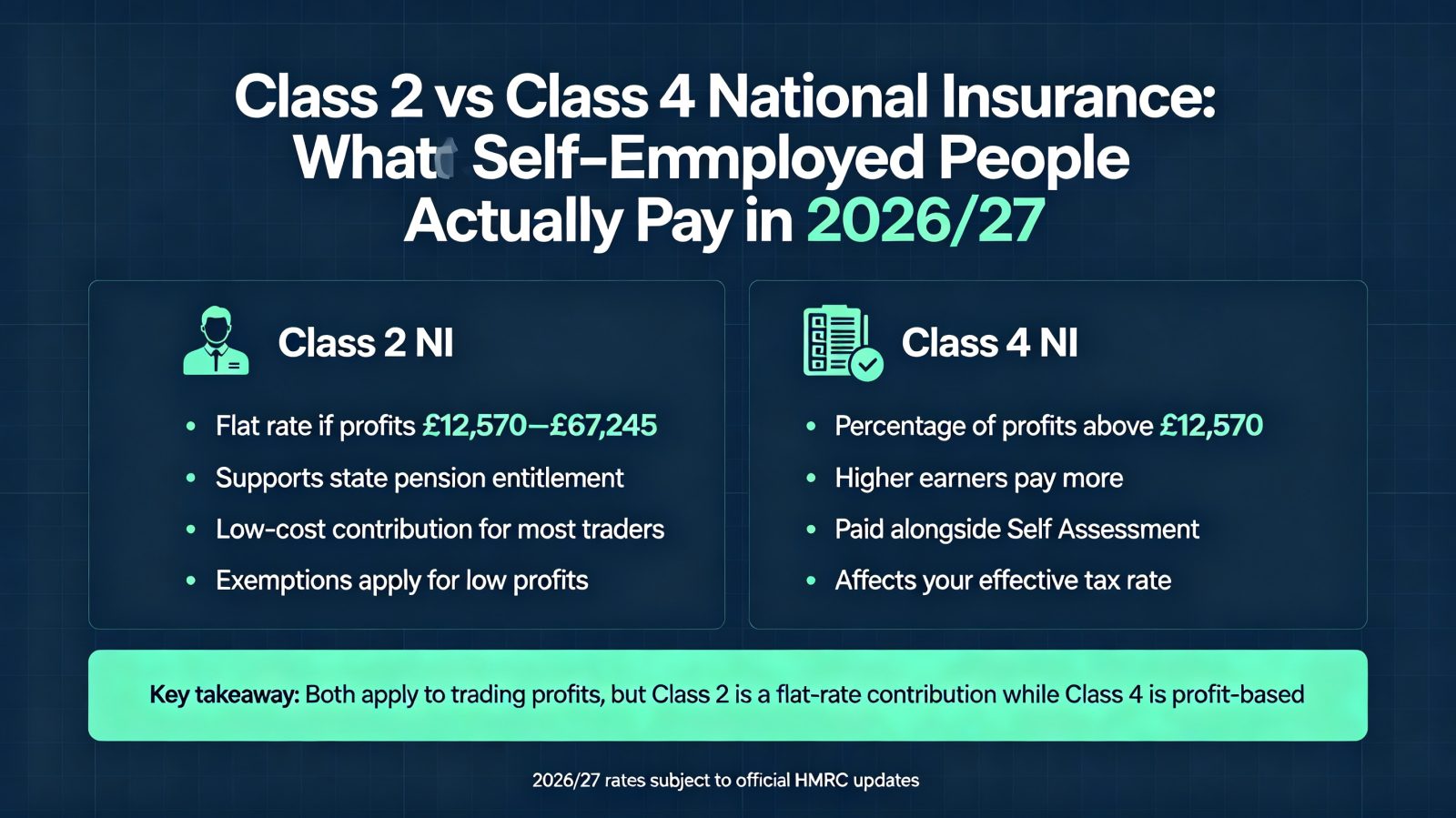
If you're self-employed and you've tried to work out your own National Insurance bill, you've probably run into conflicting information. A lot of guides — including, until recently, some of our own calculator copy — still describe Class 2 National Insurance the old way: as a flat weekly charge you pay once your profits cross a threshold. That description was accurate for years. It stopped being accurate in April 2024, and the change is significant enough that it's worth explaining properly rather than in a single FAQ line.
This guide covers what Class 2 and Class 4 NI actually are, exactly how each one works for the 2026/27 tax year, and — most importantly — clears up the specific point that trips people up: whether you actually pay Class 2 NI at all.
The short version
For most self-employed people with reasonable profits, here's the 2026/27 reality in one sentence: you don't pay Class 2 National Insurance any more, but you still get the State Pension credit for it, and you do pay Class 4 as a genuine tax on profits above £12,570.
If that sounds different from what you remember, you're not wrong to be confused — it changed relatively recently, and a lot of content online (calculators included) hasn't caught up.
Class 2 National Insurance: what it used to be, and what it is now
Class 2 was historically a flat weekly charge — a fixed amount, regardless of how much you earned, as long as your profits were above a threshold called the Small Profits Threshold (SPT). It wasn't a percentage of your income like Income Tax or Class 4; it was a set amount, a bit like a subscription, that bought you a qualifying year towards your State Pension and certain contributory benefits.
Then, from 6 April 2024, the government abolished the requirement to pay Class 2 for the majority of self-employed people. Specifically:
If your profits are £7,105 or more for 2026/27 (this is the Small Profits Threshold, which HMRC reviews each year — it was slightly lower in earlier years), you are automatically treated as having paid Class 2 National Insurance, without actually paying anything. You get the National Insurance credit — the qualifying year towards your State Pension — for free. This is the single most important thing to understand: for most people reading this, Class 2 now costs nothing but still protects your pension record.
If your profits are below £7,105, you don't get that automatic credit. You have the option to pay Class 2 voluntarily if you want to protect your State Pension entitlement for that year — for example, if you had a slow year, took time off, or are just starting out and profits are low. The voluntary rate for 2026/27 is £3.65 a week (£189.80 for a full year), up slightly from £3.45 in 2025/26.
So the two scenarios are genuinely different in mechanism, not just in amount:
Your 2026/27 profitsWhat happens with Class 2£7,105 or moreCredited automatically. You pay nothing, but still get the qualifying year.Below £7,105No automatic credit. You can choose to pay £3.65/week voluntarily to get the qualifying year anyway.
If you're used to older guidance that says "Class 2 is £3.45 (or £3.50, in even older guidance) a week if your profits are above the threshold," that description has it backwards for anyone above £7,105 in 2026/27 — above that threshold is exactly when you don't pay anything.
Why this change happened
The reform was designed to simplify things and, in effect, cut a small cost for low-and-middle-earning self-employed people, most of whom were previously paying a flat sum that bore no relation to how much they actually earned. Someone making £8,000 profit and someone making £45,000 profit used to pay the identical Class 2 amount; now, neither pays it (assuming both are above £7,105), and both still get their qualifying year. The people who lost out slightly, if anyone did, are those with profits below £7,105 who previously might have paid Class 2 as a matter of course and now have to actively opt in if they want the pension credit — it's no longer automatic just because you're technically trading.
Why you should still care, even though it's "free"
Because the credit is automatic above £7,105, it's easy to assume Class 2 is irrelevant now and stop thinking about it. There's one situation where that's a mistake: if your profits genuinely are below £7,105 in a given year — a slow year, a part-time side hustle, your first year trading — the credit does not happen automatically. If you skip paying voluntary Class 2 in a year like that, you can end up with a gap in your National Insurance record, which can affect your future State Pension amount and your entitlement to certain benefits (like Maternity Allowance) if you need them. £189.80 for a full year of protection is generally considered good value compared to the alternative of a Class 3 voluntary contribution (which is far more expensive and doesn't count towards contributory benefits the same way Class 2 does).
Class 4 National Insurance: the one that's actually a tax on profit
Unlike Class 2, Class 4 hasn't had a structural overhaul recently — it works broadly the way it always has, as a percentage-based charge on your trading profits, calculated and paid through Self Assessment alongside your Income Tax.
For 2026/27:
- 0% on profits up to £12,570 (matching the Income Tax Personal Allowance)
- 6% on profits between £12,570 and £50,270
- 2% on profits above £50,270
Unlike Class 2, Class 4 contributions do not count towards your State Pension or contributory benefits — they're a straightforward tax on your self-employment profits, distinct in purpose from Class 2 even though both are labelled "National Insurance." This is a common point of confusion: many people assume all NI contributes to their pension record in the same way, but Class 4 doesn't. Its only function is revenue — it funds the same pot as other NI classes, but it doesn't buy you anything individually the way Class 2 does.
Worked example: £35,000 profit, 2026/27
Let's put both classes together for a sole trader with £35,000 in taxable profit and no other income:
- Class 2: Profits are above £7,105, so Class 2 is credited automatically. Cost: £0.
- Class 4: £35,000 − £12,570 = £22,430 of profit is above the threshold, taxed at 6% = £1,345.80.
- Income Tax (for context): £22,430 taxed at 20% = £4,486.
Total National Insurance for the year: £1,345.80. Total Income Tax: £4,486. Combined tax and NI bill: £5,831.80, against £35,000 profit — an effective combined rate of roughly 16.7%.
Worked example: £60,000 profit, 2026/27
For a higher-earning sole trader:
- Class 2: Still credited automatically at no cost.
- Class 4: 6% on the band between £12,570 and £50,270 (£37,700 × 6% = £2,262), plus 2% on the remaining £9,730 above £50,270 (£9,730 × 2% = £194.60). Total Class 4: £2,456.60.
- Income Tax (for context): 20% on £37,700 = £7,540, plus 40% on £9,730 = £3,892. Total: £11,432.
Total NI: £2,456.60. Total Income Tax: £11,432. Combined: £13,888.60 against £60,000 profit — an effective combined rate of roughly 23.1%.
Notice that Class 4's rate drops from 6% to 2% above £50,270, the same point at which Income Tax jumps from 20% to 40%. This mirrors the structure of employee Class 1 NI (8% then 2% at the same Upper Earnings Limit), and it means the marginal cost of an extra pound of profit above £50,270 is 42p (40p Income Tax + 2p Class 4), compared to 26p below that threshold (20p + 6p).
Where this leaves you
If you're budgeting or setting aside money for your tax bill, the practical upshot for 2026/27 is:
- Don't set aside money for Class 2 if your profits will be above £7,105 — you won't be charged it, and doing so just ties up cash you don't need to.
- Do check your profits against £7,105 if you've had a genuinely low-income year — if you're under that threshold, decide deliberately whether to pay the £189.80 voluntary Class 2 for the year, rather than letting it lapse by default.
- Budget for Class 4 as a real cost — 6% on profits between £12,570 and £50,270, 2% above. This is not optional and not something that becomes free; it's collected through Self Assessment the same as Income Tax.
- Remember Class 4 doesn't protect your pension — if State Pension years matter to you, that protection comes from Class 2 (automatic above £7,105, voluntary below it), not from Class 4.
Our Sole Trader Tax Calculator works out your full Income Tax and Class 4 liability for any profit level, and factors in the current, correct Class 2 treatment for 2026/27.
Sources
- HMRC: Self-employed National Insurance rates
- HMRC: National Insurance credits
- HMRC: Voluntary National Insurance contributions
- HMRC: Rates and thresholds for employers 2026 to 2027
This article reflects HMRC's published rules as of September 2026. Individual circumstances vary — for advice specific to your situation, including whether voluntary Class 2 contributions make sense for you, speak to a qualified accountant or check your State Pension forecast directly with HMRC.
Frequently asked questions
Only if your profits are below £7,105 for 2026/27, and even then it's optional (voluntary). If your profits are £7,105 or more, you're automatically credited with a qualifying year at no cost — you don't pay anything.
£3.65 a week, or £189.80 for a full year, up from £3.45/week in 2025/26.
Class 2 protects your State Pension record (automatic above £7,105 profit, voluntary below it, and costs nothing if you're above the threshold). Class 4 is a genuine tax on your profits — 6% between £12,570 and £50,270, 2% above — and does not count towards your State Pension.
Some guidance and older calculators still reflect the pre-April 2024 rules, when Class 2 was a mandatory flat weekly charge for anyone above the Small Profits Threshold. That changed in April 2024 — check the source is dated after that reform.
Generally yes if you can afford it — at £189.80 for a full year, it's significantly cheaper than a Class 3 voluntary contribution and protects your State Pension entitlement for that year.