2026/27 UK Salary Calculator: Estimate Your Take-Home Pay
See exactly what lands in your bank account after Income Tax, National Insurance and pension contributions

A pay rise in 2026 could actually leave you with less spending power than you had a year ago. It sounds wrong, but with the personal allowance frozen at £12,570 until 2031, fiscal drag is quietly pulling thousands of workers into higher tax brackets. You've likely noticed that your monthly payslip doesn't seem to reflect your hard work, especially when you factor in complex National Insurance changes and shifting student loan thresholds. It's frustrating to see a hard-earned bonus or increment disappear into a black hole of deductions before it even reaches your bank account.
Our 2026/27 UK salary calculator provides an instant, accurate breakdown of your net pay so you can plan your finances with total confidence. We'll show you exactly how much hits your account after HMRC takes their cut, including specific calculations for those subject to Scottish tax rates. You will also discover how to navigate the 60% tax trap and protect your income from hidden fiscal traps. We will break down the impact of pension contributions and the halved dividend allowance, ensuring you have a clear, private way to track your earnings without any registration or data risks.
Key Takeaways
- Master the 2026/27 tax bands and National Insurance rates to understand how frozen thresholds impact your monthly budget.
- Get an instant, HMRC-aligned breakdown of your net pay using our privacy-focused 2026/27 UK salary calculator.
- Learn how to avoid the 60% tax trap and use pension contributions to effectively reclaim your personal allowance.
- Explore how salary sacrifice schemes can lower your tax bill while funding electric vehicles or cycle-to-work equipment.
- Understand why one-off bonuses are taxed differently and how to track your earnings long-term with a dedicated tax dashboard.
Table of Contents
- Navigating the 2026/27 UK Tax Year: What Your Paycheck Really Means
- Breaking Down the 2026/27 Income Tax and National Insurance Rates
- Beyond Gross Pay: Pensions, Student Loans, and the 60% Tax Trap
- Strategic Pay Planning: Bonuses, Salary Sacrifice, and Overtime
- Why Use the PayToolkit Salary Calculator for 2026/27?
Navigating the 2026/27 UK Tax Year: What Your Paycheck Really Means
The 2026/27 tax year officially begins on 6 April 2026 and concludes on 5 April 2027. For most UK workers, your interaction with HMRC happens through the Pay-As-You-Earn (PAYE) system. This process automatically deducts Income Tax and National Insurance (NI) before your wages ever reach your bank account. While your gross salary is the headline figure on your contract, your net pay is the only number that matters for your monthly budget. Understanding the specific deductions that occur between these two figures is essential for financial stability amongst rising living costs.
The Impact of Fiscal Drag in 2026
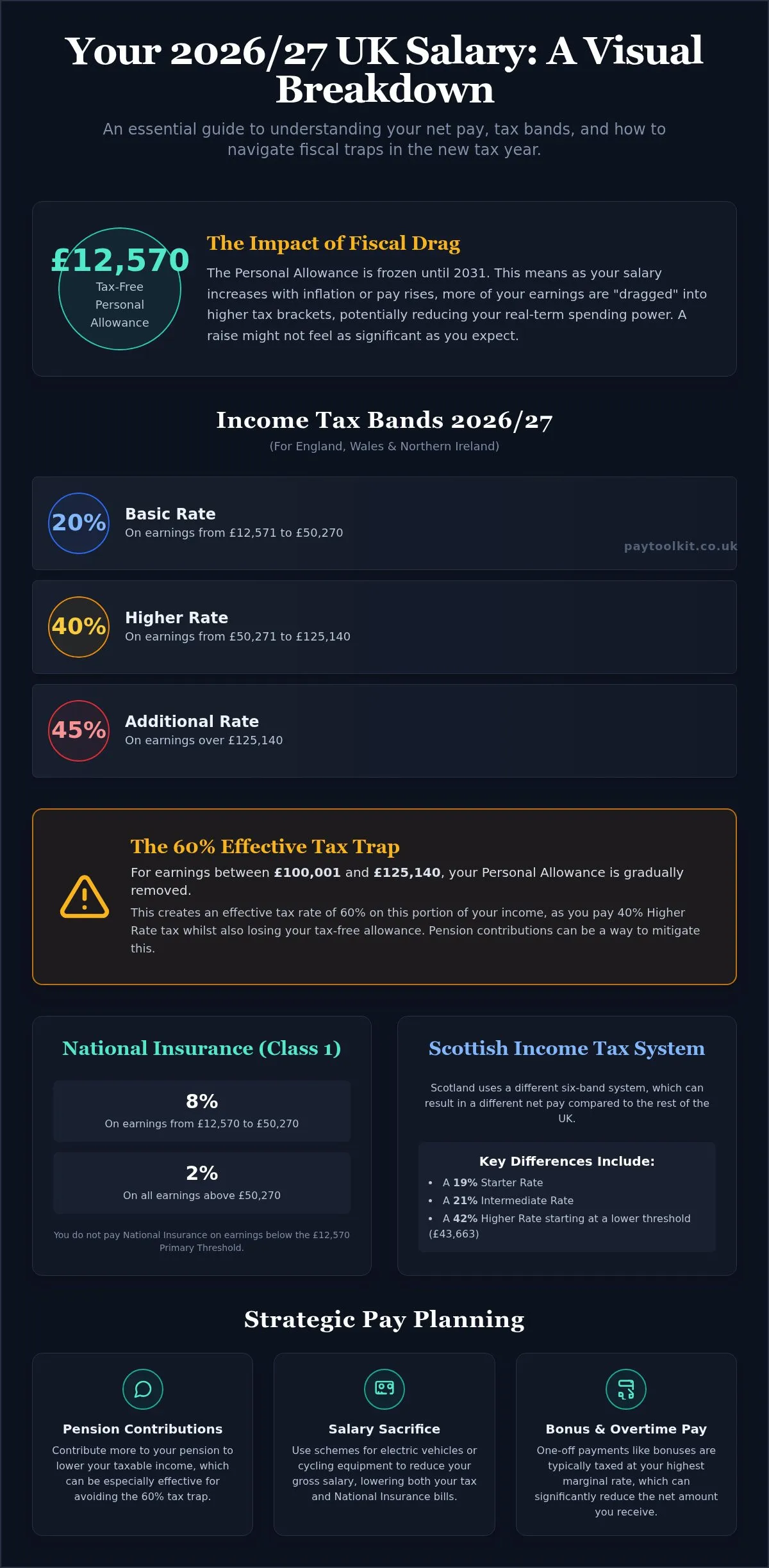
A pay rise should feel like a financial win. In 2026, it might feel more like a treadmill. The UK government has frozen the Personal Allowance at £12,570 until 2031, a policy that creates a phenomenon known as "fiscal drag." As your nominal wages increase to keep pace with inflation, a larger portion of your income is "dragged" into higher tax brackets. You might find that a modest increment pushes you over the £50,270 threshold, where you suddenly lose 40p of every extra pound earned to the Higher Rate band. Our 2026/27 UK salary calculator helps you visualise this impact. It reveals the reality of your "real-term" earnings, showing whether that recent raise actually results in more spending power or is simply swallowed by frozen thresholds.
Who is This Salary Calculator For?
We designed this tool to be a pragmatic utility for anyone navigating the UK's complex payroll landscape. It isn't just a monthly check; it's a strategic planning tool. You'll find it particularly useful if you are in one of the following positions:
- Full-time and part-time employees: Use it to verify that your tax code is applied correctly and your monthly deductions align with the latest HMRC rates.
- Job seekers: Evaluate new job offers by looking beyond the gross salary. Different pension schemes or student loan repayments can significantly alter your final take-home figure.
- Employees with side-hustles: If you have a secondary income, use the 2026/27 UK salary calculator to estimate your total tax liability. This helps you set aside the correct amount for your Self Assessment and avoid unexpected bills.
By providing a clear breakdown of tax, NI, and other common deductions, we aim to remove the stress of financial guesswork. Whether you're planning for a mortgage or simply trying to manage your monthly outgoings, getting an accurate net pay figure is the first step toward control.
Breaking Down the 2026/27 Income Tax and National Insurance Rates
Most employees start with a tax-free Personal Allowance of £12,570. This is the foundation of your net pay. Anything above this threshold is subject to Income Tax and National Insurance. Your specific tax code, usually found on your payslip, tells HMRC exactly how to treat your income. While the standard code is 1257L, yours might differ if you have underpaid tax or receive company benefits.
Income Tax Bands for England, Wales, and Northern Ireland
For the 2026/27 tax year, the thresholds remain frozen, meaning more of your income may fall into higher brackets as wages rise. You pay 20% on earnings between £12,571 and £50,270. If you earn more, the Higher Rate of 40% applies to income up to £125,140. Earnings beyond this point are taxed at the Additional Rate of 45%. It's useful to cross-reference your figures with the official Income Tax rates to ensure your employer is using the correct percentages for your specific bracket.
National Insurance (NI) acts as a secondary tax on your earnings. For Class 1 employees, you pay 8% on earnings between the Primary Threshold of £12,570 and the Upper Earnings Limit of £50,270. Once you cross that £50,270 mark, the rate drops to 2% on all subsequent earnings. Our 2026/27 UK salary calculator factors these tiered rates in automatically, ensuring your NI contribution is accurate down to the penny.
Scottish Income Tax: A Different Set of Rules
Scotland operates a distinct six-band system that diverges significantly from the rest of the UK. A worker in Edinburgh earning £55,000 will have a different take-home pay than someone in London on the same salary. This is because the Scottish Higher Rate is 42% and kicks in at a lower threshold of £43,663. The Scottish system includes a 19% Starter Rate and a 21% Intermediate Rate before reaching the higher tiers. You can easily toggle between UK and Scottish rates within our free take-home pay calculator to see how these regional differences affect your final bank balance.
Our tool also handles non-standard tax codes. If you have a "K" code, it indicates that your taxable income is actually higher than your gross pay, often due to unpaid tax from previous years or taxable perks like health insurance. The calculator adjusts your Personal Allowance calculation accordingly, providing a pragmatic view of your actual disposable income without the need for complex manual adjustments.
Beyond Gross Pay: Pensions, Student Loans, and the 60% Tax Trap
Gross salary is a starting point, but it's rarely the ending. Deductions like pension contributions and student loans create a significant gap between your contract and your bank balance. Pension contributions are a powerful tool because they reduce your taxable income. If your employer uses a "Net Pay" arrangement, the money leaves your pay before tax is calculated. This effectively lowers your tax bill whilst you build long-term wealth. It's a pragmatic way to pay your future self while keeping more money away from HMRC today.
The £100k Personal Allowance Taper Explained
High earners face a hidden penalty that many don't see coming. For every £2 you earn over £100,000, you lose £1 of your Personal Allowance. By the time your income reaches £125,140, your tax-free allowance is gone. This creates an effective 60% tax rate on income within that specific bracket. It's a psychological and financial hurdle that catches many by surprise when they receive a significant bonus or pay rise. Adjusted Net Income is the specific metric HMRC uses to calculate this taper, representing your total taxable income minus gift aid and gross pension contributions. Using a 2026/27 UK salary calculator helps you identify if you're drifting into this trap.
Student Loan Repayments and Net Pay
Student loans act as a graduate tax for millions of workers. Unlike Income Tax, these are calculated on your gross pay above a specific threshold, not your taxable pay. For the 2026/27 tax year, these thresholds are:
- Plan 1: £26,900
- Plan 2: £29,385
- Plan 4 (Scotland): £33,795
- Plan 5: £25,000
- Postgraduate Loans: £21,000
Our 2026/27 UK salary calculator organises these deductions so you can see the exact impact of your specific loan plan. It also factors in taxable benefits like company cars or private health insurance. These "Benefit in Kind" perks don't add cash to your payslip, but they do reduce your tax-free allowance. This often leads to a complex tax code change. Understanding how these benefits interact with the official Income Tax rates is vital for anyone trying to manage a precise monthly budget. It ensures your net pay figure is a reliable number you can actually use.
Strategic Pay Planning: Bonuses, Salary Sacrifice, and Overtime
Salary isn't just about the number on your contract. It's about how you structure your earnings to keep as much as possible. For the 2026/27 tax year, strategic planning is more important than ever due to frozen thresholds. Whether you're considering a new job offer or trying to understand your latest bonus, looking at the gross figure only tells half the story. You need to calculate the real-world impact of your choices on your final bank balance.
Maximising Take-Home Pay with Salary Sacrifice
Salary sacrifice is a highly effective way to lower your gross pay in exchange for a non-cash benefit. By technically earning less, you reduce your liability for Income Tax and National Insurance. This strategy is particularly powerful if you're hovering near the £60,000 threshold for Child Benefit or the £100,000 threshold where you lose your Personal Allowance. Common schemes include electric vehicle (EV) leasing, Cycle to Work, and enhanced pension contributions. It's a pragmatic way to fund your lifestyle whilst staying in a lower tax bracket. To see how these changes affect your monthly budget, simply enter your adjusted figures into our Free UK Salary & Take-Home Pay Calculator.
The "Bonus Myth": Why Bonuses Feel More Heavily Taxed
Receiving a one-off bonus often results in a "payslip shock." You might expect a standard 20% or 40% deduction but find that significantly more has been taken. This happens because the PAYE system is cumulative and forward-looking. When you receive a large sum in a single month, the system often assumes you'll earn that amount every month for the rest of the year. This can temporarily push you into a higher tax bracket or trigger higher student loan repayments. Using a 2026/27 UK salary calculator helps you see the bigger picture. By inputting your total annual income including the bonus, you get an accurate yearly net figure rather than a skewed monthly snapshot.
Overtime works in a similar way. While it's a great way to boost your income, the "real" value of those extra hours might be lower than you think. If you're a basic rate taxpayer, you'll lose 28% of your overtime pay to tax and NI. For higher rate earners, that figure jumps to 42%. If you're comparing two job offers, one with a higher base and another with better sacrifice benefits, always run the numbers for both. A lower gross salary with better benefits can often result in higher net pay. Always check your tax code after a significant pay change or bonus to ensure HMRC hasn't placed you on an emergency code, which can take months to rectify.
Our 2026/27 UK salary calculator handles these complex scenarios with ease. It allows you to toggle different pension percentages and student loan plans, giving you a transparent view of your financial reality. This level of detail ensures you can make informed decisions about your career and spending without any hidden surprises at the end of the month.
Why Use the PayToolkit Salary Calculator for 2026/27?
Finding a reliable 2026/27 UK salary calculator shouldn't mean trading your personal data for a result. Many online tools act as lead-generation engines for accounting firms or data brokers. They often require an email address or a complex sign-up process just to show you a basic breakdown of your wages. We've built PayToolkit to be a frictionless alternative. It delivers HMRC-aligned results in milliseconds. You get the precision you need without the corporate gatekeeping. It's a pragmatic utility designed to respect your time and your privacy.
Privacy and Transparency in Financial Tools
PayToolkit is an independent project built for users who value honesty. We don't need your name, your phone number, or your email to give you an accurate result. Your financial data shouldn't be a commodity. This transparency is central to how we operate. We don't track your movements or store your specific salary details on our servers. If you're managing complex finances or multiple jobs, you can use the Tax Tracker Dashboard to monitor your multi-income tracking over the full year. It provides a long-term view of your tax liability without any registration risks or hidden complications.
More Than Just a Salary Tool
Our platform is a complete centre for your tax needs. We've expanded beyond the standard 2026/27 UK salary calculator to cover the full spectrum of UK taxation. We provide specialized tools for different financial milestones, all maintaining the same high standard of accuracy:
- Sole Trader Tax & NI Calculator: Perfect for side-hustlers and the self-employed.
- Stamp Duty Land Tax (SDLT) Calculator: Essential for anyone planning a property purchase in 2026.
- Capital Gains Tax (CGT) Calculator: For investors looking to understand their liability after the latest allowance changes.
- VAT & Dividend Tax Calculators: Precise tools for small business owners and contractors.
Checking your pay shouldn't be a chore. Our mobile-optimised design ensures that you can run scenarios while you're away from your desk. Whether you're in the middle of a salary negotiation or just checking your latest payslip, the tool works seamlessly on any device. We keep our rates perfectly aligned with HMRC's latest announcements. This ensures that every calculation, from National Insurance tiers to student loan repayments, is accurate to the penny. We've removed the complex jargon and the dated interfaces found on many competitor sites. Instead, you get a clean, staccato delivery of the facts. Use the calculator today to start your 2026/27 financial planning with confidence.
Take Control of Your 2026/27 Finances
Navigating the UK tax system shouldn't be a guessing game. With the personal allowance frozen at £12,570 and fiscal drag pushing more earners into higher brackets, understanding your net pay is essential for accurate budgeting. You now have the knowledge to identify the 60% tax trap and use strategies like salary sacrifice or increased pension contributions to protect your income. These small, strategic adjustments can make a significant difference to your monthly bank balance whilst ensuring you're building long-term wealth.
Our 2026/27 UK salary calculator provides the immediate, precise data you need to make informed career and financial decisions. It's a 100% private utility aligned with the latest HMRC rates, requiring no sign-ups or personal details. Whether you're comparing new job offers, evaluating a bonus, or simply checking your monthly payslip, you can get the facts without any privacy risks. It's the fastest way to see exactly where your money goes each month.
Estimate your 2026/27 take-home pay with our free calculator. Start planning today and ensure you're keeping as much of your hard-earned salary as possible. You've done the work, now make sure you're getting the most out of your pay.
Frequently asked questions
The standard Personal Allowance for the 2026/27 tax year is £12,570. This is the amount you can earn before you start paying Income Tax. This threshold has been frozen at this level since April 2022 and is expected to remain the same until 2031. If your income exceeds £100,000, this allowance reduces by £1 for every £2 of additional income. You can use our 2026/27 UK salary calculator to see how this reduction impacts your final net pay.
For the 2026/27 tax year, Class 1 employee National Insurance rates are 8% on earnings between £12,570 and £50,270. Any income above the £50,270 Upper Earnings Limit is subject to a lower rate of 2%. These contributions are deducted automatically via the PAYE system. Our calculator accurately reflects these specific tiers, ensuring your monthly take-home pay estimate matches the latest HMRC thresholds. Employers currently pay a separate rate of 15% on earnings above £5,000.
Yes, our tool fully supports the distinct 2026/27 Scottish Income Tax bands. Scotland utilises a six-tier system, including a 19% Starter Rate and a 42% Higher Rate that begins at £43,663. Simply select the "Scotland" option within the calculator to see your specific results. This is vital for accuracy because a £50,000 salary in Edinburgh results in a different net pay figure compared to the same gross salary in Cardiff or London.
HMRC treats a one-off bonus as part of your total annual income. When you receive a lump sum, the PAYE system may temporarily assume you will earn that higher amount every month for the rest of the year. This often triggers a significantly higher tax deduction in that specific payslip. To see the true impact, enter your total projected annual earnings into the 2026/27 UK salary calculator. This provides a clear view of your actual yearly tax liability.
The 60% tax trap occurs when your income falls between £100,000 and £125,140. In this bracket, you pay 40% in Higher Rate tax plus an additional 20% due to the tapering of your Personal Allowance. You can avoid this by using our calculator to model salary sacrifice scenarios. Increasing your pension contributions can lower your Adjusted Net Income back below the £100,000 threshold, effectively reclaiming your full tax-free allowance and reducing your overall tax bill.
Our calculator handles these complex deductions simultaneously. You can input your specific pension contribution percentage and select from all current student loan plans, including Plan 1, Plan 2, Plan 4, Plan 5, and Postgraduate loans. The tool applies these deductions in the correct order. Pensions usually reduce your taxable income, while student loans are calculated on your gross pay above the relevant threshold. This ensures your final net pay figure is as accurate as possible.
Your data is completely secure because we do not store it. PayToolkit is a privacy-focused utility that requires no registration, name, or email address to function. All calculations happen instantly without any personal data being saved to our servers or sold to third parties. We built this tool to provide a transparent, frictionless experience for users who want accurate financial answers without the typical corporate tracking or marketing emails found on other tax sites.
Once your income exceeds £100,000, your take-home pay is affected by the gradual removal of your Personal Allowance. For every £2 earned above this limit, you lose £1 of your tax-free allowance until it reaches zero at £125,140. Additionally, you will be paying the Higher Rate of 40% on all income in this bracket. Use our tool to track these changes and consider whether pension contributions could help you stay below this critical threshold to maximise your monthly budget.